



Ankle sprains can be treated non-operatively
or operatively. The treatment goal is to stabilize the ankle, prevent
any further abnormal motion, and rehabilitate the ankle to full
strength. The treatment plan is determined by the severity of the
injury. Patients with an ankle fracture will often require surgery
from an orthopedic surgeon.
Non-Operative Treatment
Most ankle sprains require Rest, Ice, Compression and Elevation
(RICE), followed by rehabilitation and muscle strengthening.
When the ankle sprain is managed immediately with RICE, symptoms
may be minimized despite the severity of injury.
Rest
Painful activities that may extend the injury or prevent full recovery
should be avoided. When walking, a support or brace will help prevent
re-injury. Ligaments heal best with minimal stress, so limited
walking while protected by a brace or cast is recommended. Crutches
are prescribed in most cases, but are not necessary in the recovery
if the patient has a mild sprain that is immediately supported by
a brace.
Ice
Ice is applied to reduce the amount of swelling and relieve the
pain. Crushed ice placed in a waterproof plastic bag with a small
amount of water is recommended immediately after injury. Crushed
ice is preferred, as it easily conforms to the shape of the ankle
and provides cold within the joint where the ligaments are located.
The ice bag can be secured in place with an elastic bandage or plastic
wrap. The skin should be monitored for frostbite. Ice should
be applied for 20 minutes every 4 hours until the swelling stabilizes.
A satisfactory alternative to crushed ice is a bag of frozen corn
or peas wrapped around the injured ankle with plastic wrap. Heat
is not recommended as it may increase the amount of swelling.
Other alternatives to crushed ice are "instant ice" and frozen gel,
but both of these options are not as effective as crushed ice.
Compression
Wrapping the ankle with an elastic wrap from the toes to above the
ankle will give mild support. Most physicians prescribe an elastic
bandage or brace that will compress and support the ankle. The additional
pressure of the wrap further minimizes swelling. Taping of the ankle
for less severe sprains will provide support and a level of confidence
to the injured person as ankle movements are regained. Padding,
such as six to eight layers of four inch square cotton pads or disposable
diapers, should be firmly placed under the elastic wrap, as ankle
sprains usually occur in areas where the wrap alone would be ineffective.
Elevation
The sprained ankle should be elevated above the waist to relieve
discomfort and prevent additional swelling. The ankle should be
propped up on pillows, especially at night.
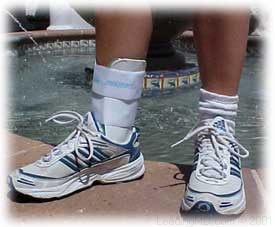 Protection
Another important element of the non-operative treatment program
is Protection. This changes the RICE formula to PRICE. Protection
takes the form of casting or using a walking boot for the more severe
unstable ankle sprain. A stirrup type brace (such as the Aircast
Air Stirrup brace) is quite effective for protecting the majority
of ankle sprains.
Overall,
the key to a successful treatment plan is early weightbearing, supported
by a brace, and rehabilitation. In severe cases, a walking boot
is prescribed for a few weeks and the patient is instructed to put
weight on the ankle.
Medications
In addition to rest, the physician may recommend a non-steroidal anti-inflammatory
agent such as ibuprofen to help decrease the pain and reduce inflammation
within the injured ankle. Individuals with a history of drug sensitivity,
known kidney or liver problems, or a bleeding disorder, should not
use these medications. People with a history of stomach irritation
or ulcers should not take anti-inflammatory medication without physician
advice or supervision.
Operative Treatment
Potentially unstable Grade III sprains should be evaluated by an
orthopedic surgeon within a few days of the injury. Surgery for
a sprained ankle is rarely necessary, although some very severe
sprains and some ankle fractures will require an operation. Most
patients recover satisfactorily by following a non-operative treatment
plan prescribed by their physicians.
In the case of a very severe ankle sprain which requires surgery:
Post-operative immobilization is required for three to six weeks before rehabilitation begins.


© 2016 by LeadingMD.com All rights reserved.
Disclaimer